
Best overall for village-centered daily life: Huntington. Best for suburban flexibility: Smithtown. Best for a university setting: Stony Brook. This 2026 guide compares six Suffolk County communities by practical household needs; Michelle Lent serves residential buyers across Suffolk and Nassau County.
- Huntington leads the best towns in suffolk county for families shortlist for village-centered daily life.
- Smithtown suits suburban home searches; Stony Brook suits buyers prioritizing proximity to Stony Brook University.
- Babylon suits railroad-centered searches; Sayville offers a South Shore downtown; Port Jefferson offers harbor access.
- Compare school assignments, property taxes, flood exposure, and the actual commute at the address level.
Why this matters
The best town is the one that makes your ordinary week work. A recognizable downtown does not establish a manageable commute, and a community name does not establish the school district serving a particular house.
This guide uses “towns” in the everyday search sense. Huntington and Smithtown are incorporated towns; Stony Brook and Sayville are hamlets; Port Jefferson and Babylon are incorporated villages within larger towns. Those distinctions matter when you compare municipal services, taxes, and property records.
Choose the address, not just the community name. Start with the kind of daily life you want, then check whether the individual property delivers it. A shortlist should narrow your search without replacing inspections, district verification, or financial due diligence.
What makes the best Suffolk County town for your household?
Use these criteria for a 2026 home search before comparing individual communities:
- Daily destinations: Identify where you actually shop, exercise, meet friends, and handle appointments. Separate destinations you can walk to from those requiring a drive.
- Commute fit: Compare the trip from the front door, including station access, parking arrangements, transfers, and the final leg to work.
- School assignment: Verify the district and attendance assignment for each address directly with the relevant district. Do not substitute a listing’s town label for confirmation.
- Ownership obligations: Review property taxes, insurance, inspection findings, utility arrangements, and any village-related obligations together.
- Property suitability: Check usable outdoor space, interior layout, road exposure, and the maintenance your household is prepared to handle.
- Environmental exposure: Consult FEMA flood mapping and local property records. Waterfront proximity and flood risk are different questions, and both need address-specific answers.
Do not rank communities by a single school score or assume that a larger house solves a location problem. Your strongest candidate meets the nonnegotiable requirements without creating an unacceptable daily trade-off.
Suffolk County communities at a glance
The order below is a decision guide, not a statistical ranking of school quality, safety, or investment performance. Each community earns a different use-case slot.
| Community | Best for | Standout characteristic | Key limitation |
|---|---|---|---|
| Huntington | Village-centered daily life | Downtown restaurants, shops, and cultural destinations | Huntington station is in Huntington Station, separate from the village center |
| Smithtown | Suburban flexibility | Multiple hamlets within the larger town | A Smithtown mailing address alone does not describe the immediate setting |
| Stony Brook | University proximity | Stony Brook University and a historic village area | The university, village area, and station are separate destinations |
| Port Jefferson | Harbor-centered living | Village harbor and ferry connection | Port Jefferson station is in Port Jefferson Station, outside the village |
| Sayville | South Shore downtown living | Main Street district and nearby bay access | Downtown access does not establish flood exposure or station convenience |
| Babylon | Railroad-centered home searches | Village station on the LIRR’s Babylon Branch | Station proximity does not guarantee a quiet residential setting |
1. Huntington: best for village-centered daily life
Huntington is the strongest starting point if you want a downtown to anchor your routine. The village area brings restaurants, shops, the Paramount, and Heckscher Park into the same general search area, giving you concrete destinations to assess rather than an abstract promise of community life.
Be precise about geography. Huntington village and Huntington Station are not interchangeable, and the railroad station is not in the village center. A house that suits downtown errands needs a separate commute assessment.
Huntington pros:
- A recognizable downtown gives you a clear focus for neighborhood visits.
- Heckscher Park provides a specific outdoor destination to evaluate.
- You can compare homes around the village with locations elsewhere in the larger town.
Huntington cons:
- Downtown access and railroad access require separate checks.
- The broader Town of Huntington covers locations that do not share the village setting.
Best for: Buyers who want village destinations to shape daily life and will verify the work commute separately.
During a visit, walk the route from the candidate house to your intended destinations. Check crossings, sidewalks, and the return trip after dark rather than relying on distance alone.
Verdict: Buy here if village-centered daily life is your priority and the specific address passes your commute test.
2. Smithtown: best for suburban flexibility
Smithtown belongs on your shortlist when you want to compare different suburban settings within one larger town. The town includes communities such as Kings Park, Nesconset, and St. James, so a search limited to the word “Smithtown” misses important distinctions.
Start by choosing the setting you want: proximity to a local center, station access, or a more residential immediate area. Then compare actual addresses. The town name is a search boundary, not a description of every street inside it.
Smithtown pros:
- Multiple communities support a broader location comparison.
- You can build separate shortlists around local centers and railroad stations.
- The town offers an alternative to a search focused exclusively on incorporated villages.
Smithtown cons:
- Broad search filters can combine substantially different locations.
- A town or mailing label does not confirm school assignment or daily travel requirements.
Best for: Buyers who want suburban flexibility and are willing to compare individual hamlets and neighborhoods.
For each house, map the same destinations: work, school, groceries, and your most frequent activity. That consistent test is more useful than comparing town names without a shared standard.
Verdict: Buy here if the individual neighborhood fits your routine; skip a town-wide assumption about convenience.
3. Stony Brook: best for proximity to the university
Stony Brook is a practical candidate if Stony Brook University is a regular destination for your household. The hamlet also has a historic village area, creating a different search focus from a community chosen primarily around a downtown railroad station.
Keep the university, village area, and LIRR station separate on your map. They serve different purposes, and a house positioned conveniently for one is not automatically convenient for the others.
Stony Brook pros:
- The university provides a clear geographic anchor for work-related searches.
- The historic village area gives you another distinct destination to assess.
- A local LIRR station supports comparison between driving and railroad travel.
Stony Brook cons:
- “Near Stony Brook” is too broad to establish a useful daily route.
- University access does not determine school assignment or property suitability.
Best for: Buyers whose regular schedule includes Stony Brook University and who want to compare nearby residential options.
Test the route to the exact campus destination you use, not merely to a university entrance. Parking and the final walk belong in the commute assessment, just as they do for a railroad trip.
Verdict: Buy here if university proximity solves a recurring household need and the home meets your other requirements.
4. Port Jefferson: best for harbor-centered living
Port Jefferson earns its place for buyers who want a village harbor to be part of their surroundings. The village has a downtown waterfront setting and a ferry connection to Bridgeport, Connecticut—distinct features that deserve their own use-case slot.
Do not confuse Port Jefferson village with Port Jefferson Station. The LIRR station is outside the village, so a harbor-focused house search still needs a separate railroad access check.
Port Jefferson pros:
- The harbor creates a specific destination for evaluating nearby homes.
- The ferry connection is relevant if cross-Sound travel serves your routine.
- The village center supports a focused, on-foot neighborhood visit.
Port Jefferson cons:
- Village and station locations are separate.
- Waterfront-oriented searches require careful property-level flood and insurance review.
Best for: Buyers who prioritize a harbor setting and have confirmed their everyday transportation needs.
Walk beyond the waterfront during your visit. The route between a candidate house and the village center matters as much as the destination itself; evaluate the street conditions you will encounter regularly.
Verdict: Buy here for harbor-centered living, not on the assumption that the village and railroad station share a location.
5. Sayville: best for a South Shore downtown
Sayville is a strong candidate if your search centers on a South Shore Main Street setting. Its downtown, local railroad station, and Great South Bay context give you distinct points to compare when deciding where a house should sit.
Keep those points separate. A listing described as being in Sayville does not establish walking access to downtown, a convenient station route, or the environmental conditions at the property.
Sayville pros:
- Main Street provides a clear center for local destination checks.
- The LIRR station gives railroad commuters a location to assess.
- The bay setting suits buyers who specifically want a South Shore search.
Sayville cons:
- A hamlet name does not establish municipal or school boundaries.
- Bay proximity requires address-specific flood mapping and insurance review.
Best for: Buyers who want a South Shore downtown and will evaluate transportation and property exposure independently.
For a 2026 purchase, ask whether downtown access is something you will use regularly or simply something you like during a visit. The answer should affect how heavily you weight it against layout and commuting needs.
Verdict: Buy here if the South Shore setting serves your routine and the property passes environmental due diligence.
6. Babylon: best for a railroad-centered search
Babylon is the clearest candidate on this list for buyers who want to organize their search around a village railroad station. Babylon station serves the LIRR’s Babylon Branch, and the village also has a downtown district to include in your route planning.
Distinguish Babylon village from the larger Town of Babylon. A property elsewhere in the town does not inherit the village’s station access or downtown setting simply because the broader municipal name matches.
Babylon pros:
- The station creates a concrete starting point for commute comparisons.
- The village downtown offers destinations to combine with a station-area visit.
- You can assess walking routes between homes, the station, and local businesses.
Babylon cons:
- Railroad proximity requires checking noise at the actual property.
- A village location still needs flood, tax, and school-assignment verification.
Best for: Buyers who put railroad access first and want to assess a village setting around that requirement.
Use the MTA’s current timetable for your intended travel period. Measure the entire door-to-door journey rather than comparing only the scheduled train segment.
Verdict: Buy here if the verified railroad commute fits your schedule and the immediate setting fits your home life.
How these communities are ranked
This 2026 ranking prioritizes identifiable location features: village destinations, suburban search flexibility, university proximity, harbor access, South Shore setting, and railroad access. It does not assign unsupported scores to schools, crime, affordability, or future property appreciation.
Huntington is the default because its village-centered use case is a clear starting point for this guide. A household with a fixed university destination or railroad requirement should move Stony Brook or Babylon ahead of it. Your requirements—not the list order—make the final decision.
Turn the shortlist into an address-level decision
Michelle Lent provides Suffolk County residential buying services; use an address-level brief to make that search specific. State what must work, what you can compromise on, and what would rule a property out.
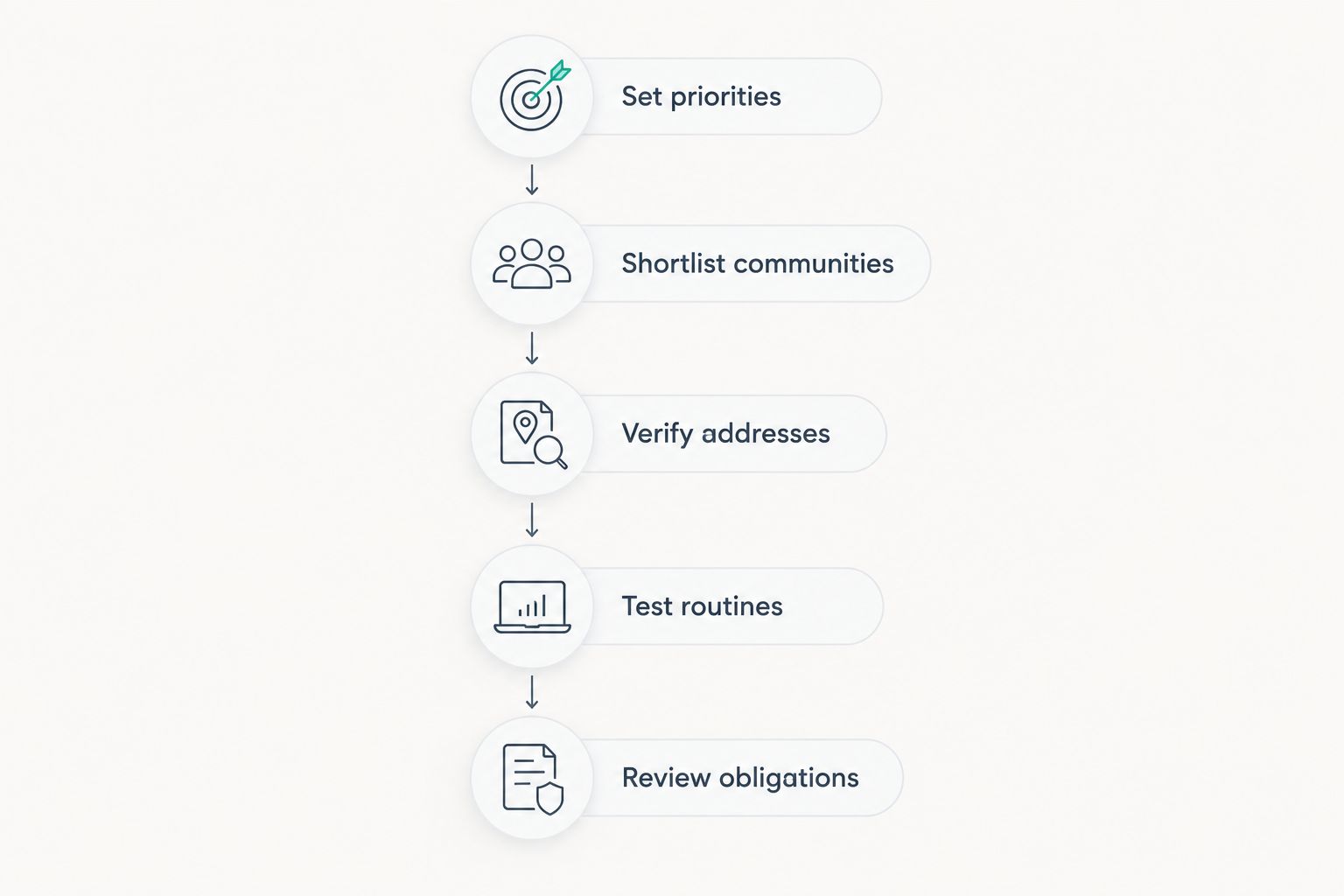
Use this sequence for your 2026 search:
- Set priorities: Write down your nonnegotiable commute, layout, and daily destinations.
- Shortlist communities: Start with 3 communities that answer different needs rather than collecting an unfocused county-wide list.
- Verify addresses: Confirm school assignments, taxes, flood mapping, and property details through the relevant official records.
- Test routines: Make 2 visits at different times and take a 30-minute test walk around each serious candidate.
- Review obligations: Examine inspection findings and insurance requirements before treating a preferred location as a completed decision.
Those visit counts are planning recommendations, not research findings. Use more visits when a recurring condition—traffic, noise, or the school-day route—remains unresolved.
Use school districts for assignment confirmation, municipal records for property obligations, FEMA for flood mapping, and the MTA for railroad schedules. Each source answers a different question; none replaces a physical visit or a home inspection.
Discuss your Suffolk County home search
Compare residential options around your commute, daily destinations, and property requirements.
Which Suffolk County community should you choose?
Start with Huntington if you are undecided and want village-centered daily life. Compare Smithtown for suburban flexibility, Stony Brook for university proximity, Port Jefferson for the harbor, Sayville for a South Shore downtown, and Babylon for a railroad-centered search.
Michelle Lent serves buyers comparing residential homes across Suffolk County. Bring a shortlist built around actual destinations, not just community reputations, so the property search addresses the decisions your household needs to make.
FAQ
What's the best town in Suffolk County for families in 2026?
Huntington is this guide’s default for households prioritizing village-centered daily life. Smithtown, Stony Brook, Port Jefferson, Sayville, and Babylon serve different location needs, so compare individual addresses before choosing.
Is Huntington better than Smithtown for a home search?
Huntington is the better starting point for a village-centered search; Smithtown is the better starting point for comparing multiple suburban communities. Neither town name confirms the school assignment, commute, or suitability of a specific house.
Which community should I consider near Stony Brook University?
Start with Stony Brook if the university is a recurring destination. Test the route to your specific campus destination, including parking and the final walk.
Is Port Jefferson's train station in the village?
No, Port Jefferson station is in Port Jefferson Station, outside Port Jefferson village. Assess railroad access separately from access to the village harbor and downtown.
Which Suffolk County community should I consider for railroad access?
Babylon is this guide’s railroad-centered recommendation because its village station serves the Babylon Branch. Check the current MTA timetable and the complete door-to-door trip for your intended schedule.
Does a town name tell me which schools serve a house?
No, a town or mailing name does not confirm a property's school district or attendance assignment. Verify the exact address directly with the relevant district before relying on a listing description.
Should I check flood maps when buying near the bay?
Yes, check FEMA flood mapping for the exact property and review insurance requirements. A community's coastal location alone does not establish a particular home's flood exposure.
One last thing
A favorite destination is not the same as a workable route to it. Before choosing a home in 2026, travel from its front door to the place you expect to use most often, at the time you expect to travel.
That simple check exposes the difference between liking a community and living comfortably at a particular address. Keep the location that passes the ordinary-week test, even if it was not your first favorite on the shortlist.