
Best overall for rail-focused screening: Hicksville. Best for a Nassau civic-center location: Mineola. Best for a walkable village search: Huntington Village. Best for a South Shore village search: Patchogue. Best for an East End town-center search: Riverhead. These are the best Long Island towns for investment properties to put on a strategy-specific 2026 shortlist—not a ranking of verified rental returns.
- Hicksville leads this best Long Island towns for investment properties shortlist for rail-focused screening, not verified investment returns.
- Mineola, Huntington Village, Patchogue, and Riverhead suit different location strategies; compare individual properties before choosing.
- Verify permitted rental use, property taxes, insurance, condition, and supported rents before making an offer.
- Michelle Lent serves residential buyers, sellers, and investors across Nassau and Suffolk County.
Why this matters
Choose the investment strategy before choosing the town. A property near a station, a village-center house, and an East End rental involve different location requirements. Grouping them under one promise of strong returns hides the decisions that determine whether a purchase works.
Long Island's Nassau and Suffolk market covers 2 counties, but county labels do not establish a property's permitted use or operating expenses. You need the exact address, the applicable municipality, and records supporting the proposed rental arrangement. Michelle Lent provides residential buying, selling, and valuation services across both counties.
This 2026 guide compares 5 communities by location fit. It uses towns, villages, and hamlets in the everyday search sense; their legal municipal boundaries are not interchangeable.
What makes the best Long Island investment location?
Judge every candidate against the same criteria before comparing addresses. A recognizable place name is not an investment thesis, and a station nearby does not establish a property's income.
- Permitted use: Confirm the legal dwelling configuration and the rental approvals required for your intended use.
- Location fit: Match the property to a specific use case, such as station access or a walkable village setting.
- Supported income: Use comparable rental evidence that matches the property's condition, layout, and location.
- Full ownership costs: Include taxes, insurance, maintenance, utilities you pay, management, and capital replacements.
- Exit flexibility: Consider who could buy the property later without assuming appreciation or a future conversion.
- Operational fit: Check whether you can manage the building, grounds, tenant turnover, and repairs under your ownership plan.
A property that fails the permitted-use check belongs outside your rental shortlist, regardless of its location. Resolve that question before spending time refining projected income.
Best Long Island investment locations at a glance
| Rank and location | Best for | Standout location feature | Key limitation |
|---|---|---|---|
| 1. Hicksville | Rail-focused property screening | LIRR junction in central Nassau | The community name does not establish walkable station access |
| 2. Mineola | Nassau civic-center proximity | Nassau County government center and LIRR station | A central location does not establish permitted rental use |
| 3. Huntington Village | Village-center walkability | Distinct downtown shopping and dining area | Huntington station is in Huntington Station, not the village center |
| 4. Patchogue | South Shore village-center screening | Downtown village setting and LIRR station | Waterfront-related risks require address-specific checks |
| 5. Riverhead | East End town-center screening | Downtown near the Peconic River and access toward both forks | The broader town and downtown are different search areas |
1. Hicksville: best for rail-focused investment screening
Hicksville is a hamlet in the Town of Oyster Bay in Nassau County. Its LIRR junction makes it a logical starting point when your investment strategy specifically depends on rail access.
Best for: Investors screening residential properties around an established rail connection. Define the actual walk or drive to the station before searching listings. Two properties with Hicksville addresses can have very different relationships to the station and surrounding roads.
Hicksville pros
- The LIRR junction gives you a concrete location feature to evaluate.
- A central Nassau location supports a search focused on access within the county.
- Station distance provides a practical way to separate otherwise similar listings.
Hicksville cons
- A Hicksville address alone does not prove convenient station access.
- Rail proximity does not confirm rental legality, tenant interest, or sufficient income.
- Properties near transport infrastructure require checks for noise, access, and parking conditions.
For a 2026 purchase, evaluate the route as a resident would use it. Check crossings, sidewalks, parking arrangements, and the property's entrance rather than relying on a map pin. Then compare rental evidence for similarly situated homes—not every rental carrying the same community name.
Verdict: Hold until the specific property's station access, permitted use, and operating costs support your rail-focused plan.
2. Mineola: best for a Nassau civic-center location
Mineola is an incorporated village in Nassau County and the county seat. Its government-center setting and LIRR station make it a distinct alternative to a search based only on residential neighborhood character.
Best for: Investors who want to evaluate properties near Nassau's civic center and rail service. Treat those location features as screening criteria, not proof that a particular tenant group will rent your property.
Mineola pros
- The county-government location gives the search a defined geographic focus.
- LIRR access provides another feature to assess at the property level.
- Village boundaries give you a specific municipal starting point for due diligence.
Mineola cons
- Proximity to employment or government buildings does not establish achievable rent.
- A listing's description does not prove that separate living areas are legal rental units.
- A village location still requires building-specific checks for parking, access, and condition.
Start with the property's certificate of occupancy and other applicable building records. If the investment depends on separate households occupying different areas, verify that configuration before treating the spaces as separate sources of income.
Michelle Lent's residential valuation services are relevant when you need to assess an acquisition alongside comparable residential sales. Keep that valuation question separate from the legal-use determination and your rental-income analysis.
Verdict: Hold until the documented configuration matches the income-producing use you intend to operate.
3. Huntington Village: best for village-center walkability
Huntington Village refers to the downtown area within the Town of Huntington in Suffolk County. It is not an incorporated village, and it is not the same location as Huntington Station.
Best for: Investors prioritizing access to a village-style downtown. Huntington's downtown shops, restaurants, and cultural destinations provide concrete features to assess. Whether a particular property offers practical walking access depends on the route and address.
Huntington Village pros
- The downtown area gives a walkability-focused search a clear center.
- Nearby shops and services provide specific destinations to evaluate during a visit.
- The distinction between downtown and station access helps define your investment strategy.
Huntington Village cons
- Huntington's LIRR station is in Huntington Station, not the downtown village center.
- A broad Huntington address does not establish proximity to downtown.
- Village character does not establish sufficient rental income or an acceptable purchase valuation.
For your 2026 shortlist, decide whether downtown access or rail access is the priority. Do not score a property as offering both without checking the actual routes. Visit the street during different parts of the day to assess activity, parking conditions, and the setting around the home.
Keep renovation assumptions equally disciplined. A property that needs substantial work should be evaluated on documented scope and contractor estimates, not the appeal of its neighborhood name.
Verdict: Hold until the address delivers the downtown access you want without relying on an inaccurate station-access assumption.
4. Patchogue: best for a South Shore village-center search
Patchogue is an incorporated village within the Town of Brookhaven in Suffolk County. Its downtown and LIRR station give investors a defined South Shore area to investigate.
Best for: Investors comparing properties around a South Shore village center. Keep the incorporated village, surrounding postal addresses, and individual property conditions distinct. They are not substitutes for one another.
Patchogue pros
- The downtown provides a recognizable center for a location-based search.
- A village LIRR station adds a separate access feature to evaluate.
- The South Shore setting lets you compare inland and waterfront-related location trade-offs explicitly.
Patchogue cons
- Flood exposure cannot be determined from the community name alone.
- A waterfront-related location requires property-specific insurance and physical-risk review.
- Downtown proximity does not establish parking adequacy or permitted rental use.
Check the exact parcel against current flood information and obtain an insurance quote for the proposed ownership and occupancy arrangement. Do not transfer an insurance assumption from another Patchogue property, even when the addresses appear close together.
Separate the appeal of a village location from the building's condition. Roofs, heating equipment, drainage, and structural issues belong in the acquisition budget whether the property sits near downtown or farther away.
Verdict: Hold until the property's physical risks, insurance requirements, and legal use fit your ownership plan.
5. Riverhead: best for an East End town-center search
Riverhead offers a downtown near the Peconic River and a location near the division between Long Island's North and South Forks. The Town of Riverhead covers a broader area than its downtown, so define the search boundary before comparing properties.
Best for: Investors seeking an East End location without treating every property as a vacation rental. A year-round residential strategy and a short-term rental strategy require different operating assumptions and legal checks.
Riverhead pros
- The downtown gives a town-center search a specific geographic anchor.
- The location provides a starting point for evaluating access toward either fork.
- A broader town search lets you distinguish downtown properties from less central settings.
Riverhead cons
- A Riverhead address does not establish walkable downtown access.
- East End geography does not prove that short-term rentals are permitted.
- Different rental strategies cannot share an income projection without separate supporting evidence.
Write down the intended occupancy arrangement before reviewing income estimates. If a property only appears workable under a short-term rental model, confirm the applicable rules and approvals first. Do not substitute assumed visitor demand for evidence about the property's lawful use and operating requirements.
Verdict: Hold until the specific location and permitted rental model support the investment independently of an East End label.
How to turn the shortlist into a purchase decision
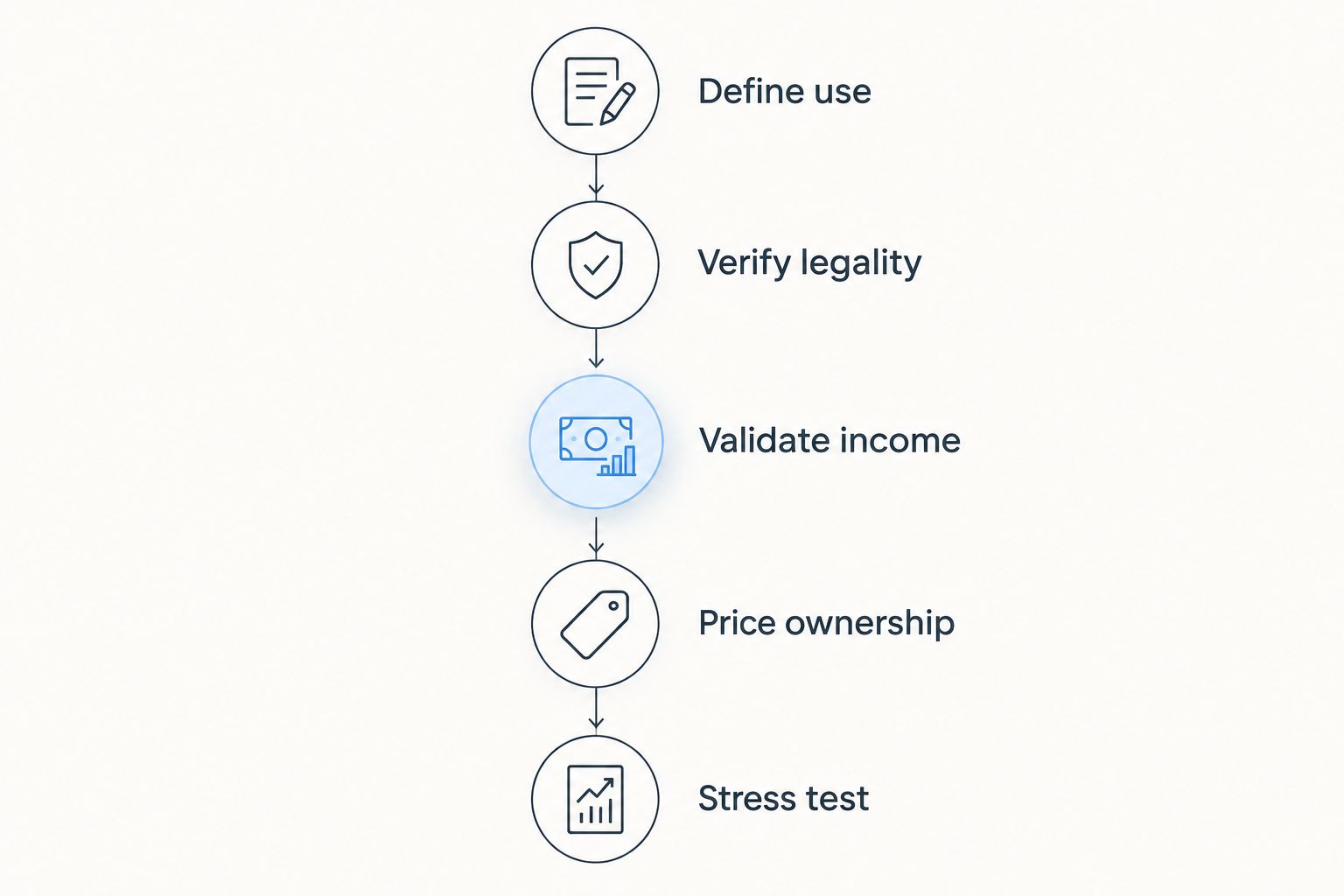
Use the same sequence for every candidate in 2026. Changing your standards because you like a neighborhood makes the final comparison less useful.
- Define use: Specify the residential occupancy arrangement you intend to operate.
- Verify legality: Confirm jurisdiction, legal configuration, and applicable rental requirements.
- Validate income: Gather comparable rental evidence and distinguish asking rents from completed agreements.
- Price ownership: Assemble taxes, insurance, maintenance, management, and replacement allowances.
- Stress test: Evaluate vacancy, repairs, and weaker income without assuming appreciation will cover a shortfall.
Build the operating model across 12 months, not just an occupied month. Annualize recurring expenses, identify costs paid by the tenant versus the owner, and keep capital replacements visible. Principal repayment and operating expenses should not be confused when assessing cash flow.
Ask for documentation behind each material assumption. A seller's income summary, a listing description, and your own forecast serve different purposes; none replaces verification of the underlying records.
Discuss your Long Island property search
Review residential buying and valuation needs across Nassau and Suffolk County with Michelle Lent.
How these locations were ranked
This ranking uses identifiable location features and distinct investment use cases. Hicksville leads for a rail-focused starting point; the remaining communities serve civic-center, village-walkability, South Shore, and East End searches.
The order is not a yield forecast. It does not establish which community has the highest rents, lowest acquisition costs, strongest appreciation, or best occupancy. Those conclusions require current, comparable property evidence.
Which Long Island location should you choose?
Start with Hicksville if rail access is your primary screening criterion. Choose Mineola for a Nassau civic-center search, Huntington Village for downtown walkability, Patchogue for a South Shore village setting, and Riverhead for an East End town-center strategy.
Michelle Lent serves residential investors across Nassau and Suffolk County. For a 2026 purchase, use the location shortlist to narrow the search, then let documented property economics and permitted use determine the decision.
FAQ
What's the best Long Island town for an investment property in 2026?
Hicksville is the first location to screen in this guide when rail access is your main criterion. That recommendation concerns location fit, not verified rental returns; the individual property's permitted use, expenses, and supported income determine whether it works.
Is Nassau County better than Suffolk County for rental properties?
Neither county is automatically better for rental properties. Compare specific addresses under the same rental strategy, using documented ownership costs, applicable rules, and comparable rental evidence.
Is Huntington Village the same place as Huntington Station?
No, Huntington Village's downtown area and Huntington Station are distinct locations within the Town of Huntington. Huntington's LIRR station is in Huntington Station, so check the actual route before treating a downtown property as a station-area investment.
Can I assume a Long Island house with an apartment is a legal rental?
No, an apartment's physical presence does not establish that its use is legal. Confirm the approved configuration and applicable rental requirements with the relevant municipality before counting separate rental income.
Should I buy near a Long Island train station?
Prioritize station access when it matches your investment strategy and the specific property provides practical access. Check the route, surrounding conditions, supported rents, and ownership costs rather than relying on distance alone.
Can I use a Riverhead property as a short-term rental?
Do not assume a Riverhead property permits short-term rentals. Confirm the rules and approvals applicable to the exact address and intended occupancy arrangement before using short-term rental income in your purchase analysis.
What should I check before buying a Patchogue investment property?
Check permitted use, building condition, taxes, insurance, supported rents, and parcel-specific flood information. A Patchogue address alone does not establish waterfront exposure, insurance requirements, or proximity to downtown.
One last thing
Ask for the documents that could disprove the investment case before asking what makes the property attractive. An unapproved unit, an unsupported rent estimate, or an omitted ownership expense can change the decision without changing anything about the town.
For Long Island investment properties, Michelle Lent provides residential buying and valuation services across Nassau and Suffolk County. Bring a defined rental strategy to the search, and keep every candidate subject to the same evidence.