
Best overall: a lender-eligible co-op with clear financial records. Best for commuters: a station-accessible building. Best for predictable budgeting: a building with documented maintenance and assessment obligations. The best Long Island co-op buildings for first-time buyers in 2026 are the ones that pass your financing, financial, and daily-life checks—not simply the ones with the most appealing apartment photos.
- The best long island co-op buildings for first-time buyers pass lender, financial, and board-rule checks before you commit.
- Rank building financials above cosmetic upgrades when comparing Nassau County and Suffolk County co-ops.
- Choose station access, predictable expenses, pet compatibility, or step-free access according to your actual needs.
- Michelle Lent provides residential buying services across Nassau and Suffolk County, Long Island.
For help with a Long Island co-op purchase, Michelle Lent provides residential buying services across Nassau and Suffolk County. Use the ranked building profiles below to decide which properties deserve a closer look; each recommendation depends on checking the individual building's documents and rules.
Why this matters
Buying a co-op means buying shares in a corporation together with the right to occupy an apartment under a proprietary lease. You are evaluating both a home and the organization responsible for the building.
An attractive apartment does not resolve questions about building debt, repairs, financing eligibility, or occupancy restrictions. Your 2026 shortlist should reflect what you can finance, what you can comfortably carry, and how you intend to live.
Choose the building before you fall in love with the renovation. Interior finishes are visible during a showing; the obligations attached to ownership require document review.
What makes the best first-time-buyer co-op?
Use these criteria before comparing finishes or amenities:
- Financing eligibility: Your lender must accept both your financial profile and the particular co-op project.
- Building finances: Review operating results, reserves, debt, and plans for major work with your attorney and lender.
- Monthly obligations: Separate maintenance, apartment financing, assessments, insurance, and expenses not included in maintenance.
- Board requirements: Establish the application process, financial requirements, occupancy rules, and supporting documents before committing.
- Daily-life fit: Verify the actual commute, parking arrangements, access, pets, and storage rules that affect you.
- Resale restrictions: Understand transfer requirements, subletting provisions, and any applicable transfer charges.
Do not turn these into a points contest. A restriction that makes the apartment unusable for you is a reason to reject it, even if everything else looks appealing.
Long Island co-op building profiles at a glance
These are ranked building profiles, not unsupported endorsements of named addresses. Start with financial and financing suitability, then select the profile that solves your most important practical need.
| Rank and building profile | Best for | Standout feature to verify | Key limitation |
|---|---|---|---|
| 1. Lender-eligible, financially documented co-op | First-time buyers without a specialized requirement | Project acceptance and accessible financial records | Lender acceptance does not replace legal or financial review |
| 2. Station-accessible co-op | Buyers whose routine depends on rail travel | A workable door-to-platform route | Station proximity does not establish the right service pattern |
| 3. Clearly budgeted co-op | Buyers prioritizing predictable obligations | Written expense breakdown and assessment information | Current charges do not guarantee future charges |
| 4. Pet-compatible co-op | Buyers with an existing pet | Written rules that accommodate the specific animal | Permission can carry conditions and approval requirements |
| 5. Step-free-access co-op | Buyers prioritizing access and reduced stair use | A continuous usable route to the apartment | An elevator alone does not establish accessible entry |
1. Lender-eligible co-op: best overall for first-time buyers
A lender-eligible co-op is the strongest starting point when you need financing. Your lender evaluates the apartment purchase and the underlying co-op project; a personal preapproval does not settle both questions.
Ask your lender to identify the project documents needed before you become emotionally committed. Have your attorney review the corporation's financial statements, proprietary lease, and relevant building records rather than treating mortgage acceptance as a general endorsement.
Best for: First-time buyers who need financing and want a document-led starting point.
Lender-eligible co-op pros:
- Establishes whether your intended financing route works.
- Brings building-level questions into the search early.
- Gives your attorney and lender a shared set of records to examine.
Lender-eligible co-op cons:
- Acceptance by one lender does not establish acceptance by every lender.
- Financing eligibility does not guarantee sound building finances or suitable rules.
For your 2026 search, ask when the lender last reviewed the project and whether anything remains outstanding. Keep the distinction clear: an acceptable project and an affordable apartment are separate decisions.
Verdict: Buy only after the lender and attorney complete their respective reviews.
2. Station-accessible co-op: best for regular rail commuters
A station-accessible co-op fits buyers whose routine depends on Long Island Rail Road travel. Judge access from the actual building entrance, not a neighborhood description or a straight-line map distance.
Walk the route you would use. Check crossings, lighting, sidewalks, and the station entrance that serves your journey; then review the timetable for your required departure and return trips.
Best for: Buyers whose work or regular travel makes station access a deciding factor.
Station-accessible co-op pros:
- Lets you evaluate the commute as a repeatable daily routine.
- Makes the station route a concrete comparison between buildings.
- Helps identify whether a car is necessary for the rail portion of your journey.
Station-accessible co-op cons:
- A nearby station does not guarantee convenient trains for your schedule.
- Nearby tracks, traffic, or station activity require an in-person noise check.
Record the walk in minutes during your own visit. Do not substitute an agent's estimate for the route, pace, and entrance you will actually use.
Verdict: Buy when the full commute works, not merely because the listing mentions a station.
3. Clearly budgeted co-op: best for predictable monthly planning
A clearly budgeted co-op gives you enough information to distinguish current recurring charges from known additional obligations. This profile suits buyers who want to understand their housing commitment before choosing an apartment.
Build your own worksheet. Include apartment financing, maintenance, assessments, insurance, utilities billed separately, and applicable parking or storage charges; keep closing expenses separate from recurring expenses.
Best for: First-time buyers who prioritize a documented household budget.
Clearly budgeted co-op pros:
- Makes expense comparisons more consistent across buildings.
- Exposes charges that an advertised maintenance figure does not explain.
- Connects planned building work with questions about future funding.
Clearly budgeted co-op cons:
- A complete current budget does not prevent future increases.
- Financial statements require interpretation, not just collection.
For 2026, ask what maintenance includes, whether assessments are active or approved, and how identified major projects will be funded. Separate confirmed obligations from unanswered questions rather than filling gaps with assumptions.
Verdict: Buy when the documented obligations fit your finances and your remaining cash needs.
4. Pet-compatible co-op: best for buyers with an existing pet
A pet-compatible co-op has written rules that accommodate your particular animal and intended occupancy. A broad description such as pet-friendly is not enough to establish permission.
Request the current policy and application requirements. Identify restrictions concerning animal type, size, number, common-area conduct, and approval before treating the apartment as a viable choice.
Best for: Buyers whose existing pet makes building policy a nonnegotiable requirement.
Pet-compatible co-op pros:
- Resolves a potentially disqualifying restriction early.
- Lets you compare the actual requirements rather than listing shorthand.
- Makes common-area expectations part of the buying decision.
Pet-compatible co-op cons:
- Permission for one animal does not establish permission for another.
- Rules can include approval conditions that require further review.
Ask your attorney how the written policy applies to your situation. Disability-related accommodation questions require separate legal consideration; do not treat an ordinary pet policy as the complete answer.
Verdict: Buy only after the applicable rules and approval requirements are clear.
5. Step-free-access co-op: best for buyers avoiding stairs
A step-free-access co-op offers a usable route between the street or parking area and the apartment without relying on stairs. Evaluate the entire route, including entrances, corridors, doors, and any elevator.
This profile belongs on your shortlist when stair use affects your daily comfort or access. Verify physical conditions directly rather than inferring them from an elevator mentioned in a listing.
Best for: Buyers who prioritize step-free entry and circulation.
Step-free-access co-op pros:
- Turns access requirements into observable building features.
- Helps you evaluate deliveries, groceries, and everyday entry.
- Encourages review of shared routes as well as apartment interiors.
Step-free-access co-op cons:
- An elevator building can still have steps at the entrance.
- Elevator outages require a practical contingency discussion.
Visit the entrance you would normally use, not just the route offered during the showing. Where access is essential, ask appropriate professionals to assess suitability for your specific needs.
Verdict: Buy when the complete route works for you, not when one feature sounds sufficient.
How to check a building before choosing an apartment
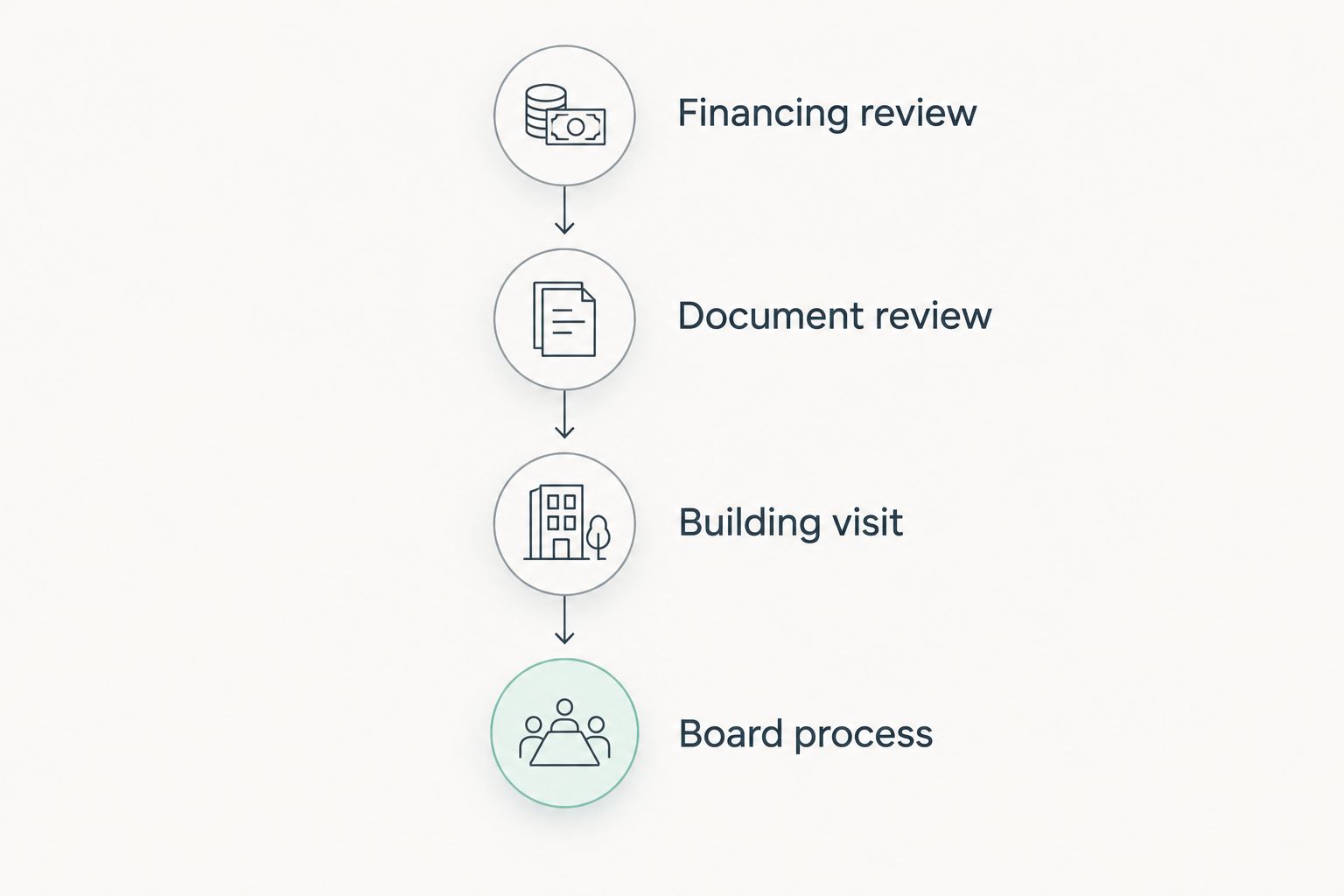
Use this sequence to move from an appealing listing to a purchase decision. Keep your lender's review, your attorney's review, and your own physical inspection distinct; none substitutes for the others.
Financing review
Give your lender the building identity early. Ask what project information is required, which items remain unresolved, and how those findings affect your intended financing.
Document review
Have your attorney request and assess the relevant financial statements, governing documents, application materials, and available records concerning building work. Ask for explanations of obligations you do not understand before signing binding documents.
Building visit
Inspect the shared spaces and your daily route. Note visible conditions for follow-up, but leave structural, mechanical, and other technical conclusions to qualified professionals.
Board process
Confirm submission requirements and the steps that apply to this transaction. Do not promise a moving date based on an assumed approval schedule.
Keep an unresolved-questions list for every serious candidate. A building moves forward when the questions have usable answers—not simply because another showing felt encouraging.
How the building profiles are ranked
Financial and financing suitability come first because the remaining preferences cannot rescue a purchase that your lender will not finance or whose obligations you cannot accept. Commute, budgeting clarity, pet rules, and access then create distinct decision paths.
This ranking does not score named buildings or claim that every property within a profile is suitable. Apply the same core checks to each candidate, even when one feature looks especially attractive.
Which Long Island co-op should you choose?
For an undecided first-time buyer, start with a lender-eligible building whose financial records and rules withstand professional review. Then choose the apartment that meets your most important daily requirement without introducing an unacceptable restriction.
Michelle Lent provides residential buying services across Nassau and Suffolk County. For a Long Island co-op search in 2026, bring your financing position, essential requirements, and unresolved building questions into the discussion before narrowing your shortlist.
Start your Long Island home search
Discuss residential buying needs in Nassau and Suffolk County with Michelle Lent.
FAQ
What's the best Long Island co-op building for a first-time buyer?
The best fit is a building that meets your lender's requirements, has financial obligations you understand, and permits your intended use. Choose a named building only after reviewing its current documents and your specific apartment purchase.
Is a Nassau County co-op better than a Suffolk County co-op?
Neither county is automatically better for a first-time co-op buyer. Compare individual buildings by financing eligibility, financial records, commute, occupancy rules, and the apartment's fit for your needs.
Does mortgage preapproval mean the co-op building is approved?
No. Personal mortgage preapproval concerns the borrower, while the lender must also evaluate the co-op project and the specific transaction.
What does co-op maintenance include?
The included expenses depend on the building. Request a written breakdown and confirm how property taxes, building debt service, utilities, and other expenses are handled before comparing maintenance figures.
Can I rent out my Long Island co-op later?
Your ability to sublet depends on the co-op's governing documents and approval requirements. Have your attorney review restrictions before buying if future rental use is part of your plan.
How do I check whether a co-op allows my dog?
Obtain the current written pet policy and confirm the approval requirements for your particular dog. A pet-friendly listing description does not establish that every animal is permitted.
What should I review before buying a co-op in 2026?
Review financing eligibility, building financials, governing documents, assessments, planned work, and board application requirements. Also verify the commute, access, and household rules that determine whether the apartment works for you.
One last thing
Ask what has changed since the financial statements were prepared. A completed document describes a reporting period; your purchase decision also needs answers about subsequent assessments, approved work, borrowing, or rule changes.
Make that a closing question in your 2026 building review, not an assumption. The best shortlist is not the longest one—it is the one where you understand the obligations attached to every apartment still under consideration.